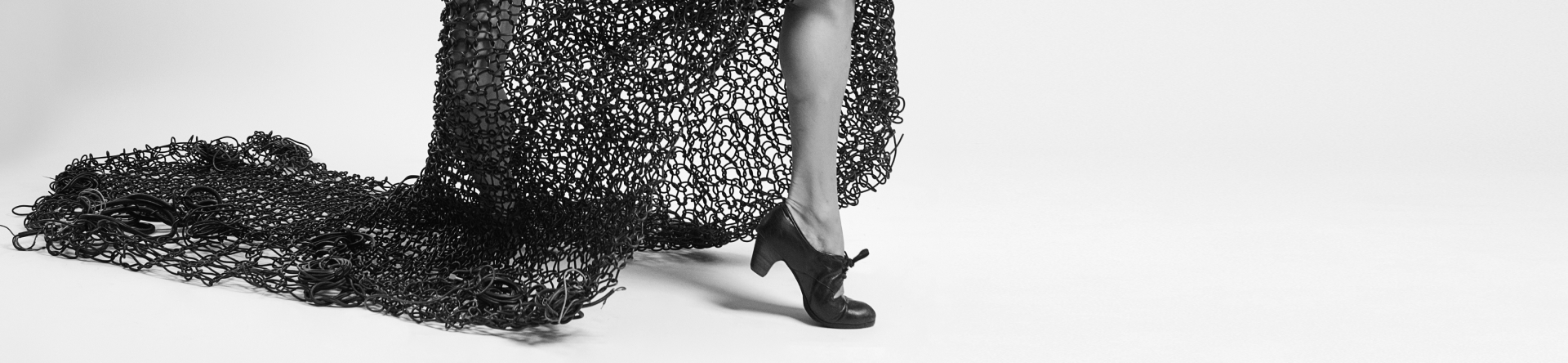
Vanesa Aibar has carved out a singular path within the flamenco landscape. Most of the public, critics—and even fellow artists—have become entangled in identity-based speculations about borders and limits. The dancer from Jaén understood very early on that the best way to resolve certain questions (especially those concerned with boundaries) is to ignore them. Thanks to this, as we were saying, she has forged an unprecedented path and, along it, has found her own calligraphy—what people like to call a style (let us remember that style comes from the Latin stilus, a pointed instrument used for writing).
Artists and their exegetes often speak of style as one might speak of creating a brand (the matter still revolves around borders); but in art, the issue is not about brands—or perhaps it is, but not in the sense used by fashion, corporations, or even countries (remember that thing called “Brand Spain”): the brand is not in the artist but in the audience. It is the audience that is (or is not) marked; it is in their guts or in their memory that the scar is inscribed. That is why we prefer to speak of aire. Aibar seems to us to be one of the few contemporary dancers who possesses a true aire of her own. And she has it precisely because dance interests her more as a means than as an end. What she does, therefore, is to probe the power of the stage as a site of transformation. To tread this ground requires outstanding technique, and Vanesa has it, but she does not become bewitched by it, nor does she revel in pure form. Aibar digs deeper, farther, more jondo; she ignores melancholic deliriums and technical hypertrophies. Her search does not take place in the realm of emotions either; rather, it points to the body as the absolute center of the matter. It is in pure physiology that she seeks answers: in muscles, tendons, and bones lies salvation from romantic delirium. For “the sweet and the bitter, the hot and the cold, the yellow and the green are nothing but opinions; only atoms and the void are true.”
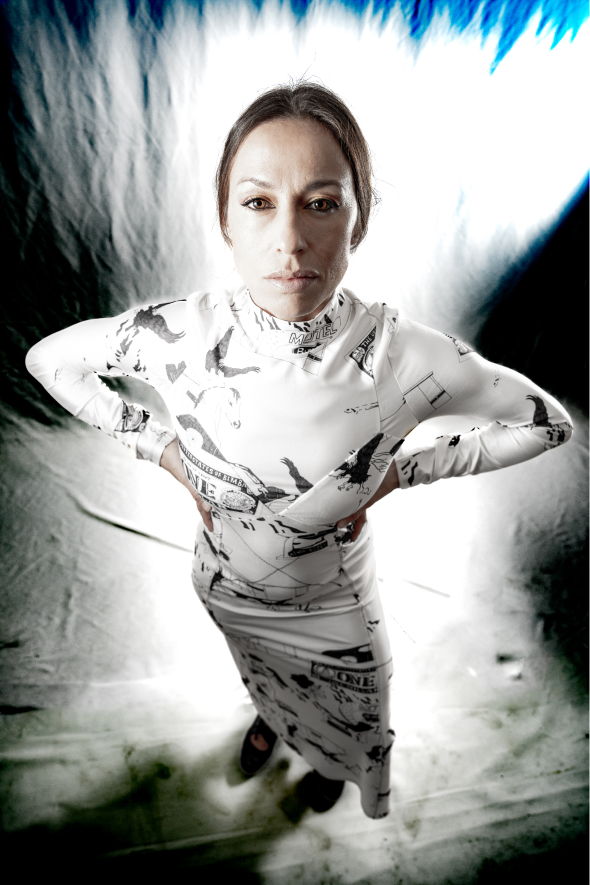
She trained in Spanish Dance and Flamenco at the “Reina Sofía” Conservatory in Granada and completed her studies at the Andalusian Dance Center in Seville. In addition, she holds a degree in Physiotherapy from the University of Granada and a postgraduate qualification as a University Specialist in Osteopathic Techniques from the University of Seville.
Her most recent stage creation, La Reina del Metal, has been recognized with numerous national and international awards, including the 2023 Max Award for Best Dance Production; a mention among the 10 best shows of 2023 in Amsterdam according to the prestigious Dutch newspaper Het Parool; the award for Best Production at the 40th edition of Palma, the Andalusian Performing Arts Fair; and awards for Best Indoor Production, Best Costume Design, and Best Scenic Space Design at the 2023 PAD Awards, granted by the Association of Dance Professionals of Andalusia. The work has also received numerous nominations for the Talía Awards of the Spanish Academy of Performing Arts, the Premis de la Crítica of Catalonia, and the Lorca Awards of Andalusia.
Other works she has created include Sierpe, Liminal, Mujer en Azul, and El Espejo.
She develops works for non-conventional spaces in which she explores the recontextualization of public places, such as Áspid, and takes an interest in audiovisual creation and the impact it has on dance, giving rise to works such as Animal Kingdom and Cierro, among others. She also generates projects aimed at expanding dance and artistic research in non-traditional environments, curating performing arts programs in rural areas and universities, as well as delivering lectures on science and dance.
Her work reveals a contemporary dialogue with female archetypes, a renewal of flamenco choreographic structures, a commitment to artistic research, and a belief in art as a form of knowledge. In addition, she forges alliances and collaborations with leading artists—Carmen Linares, Mayte Martín, Andrés Marín, Eva Yerbabuena, and Blanca Li—and actively engages in dialogue with professionals from the arts, technology, and science, such as Juan Carlos Lérida (choreographer, curator, and educator), Juan Manuel García-Ruiz (CSIC researcher at the Laboratory of Crystallographic Studies in Granada), and David Montero (playwright and performer).
Vanesa Aibar has carved out a singular path within the flamenco landscape. Most of the public, critics—and even fellow artists—have become entangled in identity-based speculations about borders and limits. The dancer from Jaén understood very early on that the best way to resolve certain questions (especially those concerned with boundaries) is to ignore them. Thanks to this, as we were saying, she has forged an unprecedented path and, along it, has found her own calligraphy—what people like to call a style (let us remember that style comes from the Latin stilus, a pointed instrument used for writing).
Artists and their exegetes often speak of style as one might speak of creating a brand (the matter still revolves around borders); but in art, the issue is not about brands—or perhaps it is, but not in the sense used by fashion, corporations, or even countries (remember that thing called “Brand Spain”): the brand is not in the artist but in the audience. It is the audience that is (or is not) marked; it is in their guts or in their memory that the scar is inscribed. That is why we prefer to speak of aire. Aibar seems to us to be one of the few contemporary dancers who possesses a true aire of her own. And she has it precisely because dance interests her more as a means than as an end. What she does, therefore, is to probe the power of the stage as a site of transformation. To tread this ground requires outstanding technique, and Vanesa has it, but she does not become bewitched by it, nor does she revel in pure form. Aibar digs deeper, farther, more jondo; she ignores melancholic deliriums and technical hypertrophies. Her search does not take place in the realm of emotions either; rather, it points to the body as the absolute center of the matter. It is in pure physiology that she seeks answers: in muscles, tendons, and bones lies salvation from romantic delirium. For “the sweet and the bitter, the hot and the cold, the yellow and the green are nothing but opinions; only atoms and the void are true.”
She trained in Spanish Dance and Flamenco at the “Reina Sofía” Conservatory in Granada and completed her studies at the Andalusian Dance Center in Seville. In addition, she holds a degree in Physiotherapy from the University of Granada and a postgraduate qualification as a University Specialist in Osteopathic Techniques from the University of Seville.
Her most recent stage creation, La Reina del Metal, has been recognized with numerous national and international awards, including the 2023 Max Award for Best Dance Production; a mention among the 10 best shows of 2023 in Amsterdam according to the prestigious Dutch newspaper Het Parool; the award for Best Production at the 40th edition of Palma, the Andalusian Performing Arts Fair; and awards for Best Indoor Production, Best Costume Design, and Best Scenic Space Design at the 2023 PAD Awards, granted by the Association of Dance Professionals of Andalusia. The work has also received numerous nominations for the Talía Awards of the Spanish Academy of Performing Arts, the Premis de la Crítica of Catalonia, and the Lorca Awards of Andalusia.
Other works she has created include Sierpe, Liminal, Mujer en Azul, and El Espejo.
She develops works for non-conventional spaces in which she explores the recontextualization of public places, such as Áspid, and takes an interest in audiovisual creation and the impact it has on dance, giving rise to works such as Animal Kingdom and Cierro, among others. She also generates projects aimed at expanding dance and artistic research in non-traditional environments, curating performing arts programs in rural areas and universities, as well as delivering lectures on science and dance.
Her work reveals a contemporary dialogue with female archetypes, a renewal of flamenco choreographic structures, a commitment to artistic research, and a belief in art as a form of knowledge. In addition, she forges alliances and collaborations with leading artists—Carmen Linares, Mayte Martín, Andrés Marín, Eva Yerbabuena, and Blanca Li—and actively engages in dialogue with professionals from the arts, technology, and science, such as Juan Carlos Lérida (choreographer, curator, and educator), Juan Manuel García-Ruiz (CSIC researcher at the Laboratory of Crystallographic Studies in Granada), and David Montero (playwright and performer).
Awards
Max Award for Best Dance Performance 2023
Award for Best Performance at the Palma del Río Performing Arts Fair 2023
Award for Best Production Designed for Non-Conventional Spaces, granted by the Dance Professionals of Andalusia (2020).
First Prize for Solo Choreography at the 26th Madrid Competition for Spanish Dance and Flamenco Choreography (2017).
Ex aequo Award for Best Choreography in Spanish Dance and Flamenco, Outstanding Bailaora Award, and “Espacio de Creación Silvestre La Muela” Award at the 3rd Choreographic Competition of the Tetuán District in Madrid (2016).
Second Prize for Solo Choreography and Special Mention for Music at the 21st Madrid Competition for Spanish Dance and Flamenco Choreography (2012).
Best Spanish Dance Choreography at the 2nd National Choreographic and Performance Competition of Seville (2009). Choreography created as a trio by Vanesa Aibar together with Manuel Roldán and Cristina Sangregorio.